1993 Aashto Guide For Design Of Pavement Structures Pdf To Jpg

. The characterization of subgrade support may be extended to other subgrade soils by an abstract soil support scale. Loading can be applied to mixed traffic by use of ESALs. Material characterizations may be applied to other surfaces, bases, and subbases by assigning appropriate layer coefficients. The accelerated testing done at the AASHO Road Test (2-year period) can be extended to a longer design period.When using the 1993 AASHTO Guide empirical equation or any other empirical equation, it is extremely important to know the equation’s limitations and basic assumptions. Otherwise, it is quite easy to use an equation with conditions and materials for which it was never intended.
AASHTO Guide for Design of Pavement Structures, 1993 American Association of State Highway and Transportation Officials, National Cooperative Highway Research Program AASHTO, 1993 - Technology & Engineering - 640 pages.
This can lead to invalid results at the least and incorrect results at the worst. InputsThe 1993 AASHTO Guide equation requires a number of inputs related to loads, pavement structure and subgrade support. These inputs are:. The predicted loading is simply the predicted number of 80 kN (18,000 lb.) ESALs that the pavement will experience over its. The reliability of the pavement design-performance process is the probability that a pavement section designed using the process will perform satisfactorily over the traffic and environmental conditions for the design period (AASHTO, 1993).
- Pavement structures american association of state highway and transportation officials aashto guide for design of pavement structures. 4th edition supplement this supplement to the aashto guide for design of pavement structures includes 1993 aashto guide for design of pavement structures pdf to jpg national asphalt.
- Volume 1; Volume 1993 of AASHTO Guide for Design of Pavement Structures, American Association of State Highway and Transportation Officials Authors American Association of State Highway and Transportation Officials, National Cooperative Highway Research Program.
In other words, there must be some assurance that a pavement will perform as intended given variability in such things as construction, environment and materials. The Z R and S o variables account for reliability. Pavement structure. The pavement structure is characterized by the Structural Number (SN). The Structural Number is an abstract number expressing the structural strength of a pavement required for given combinations of soil support (M R), total traffic expressed in ESALs, terminal serviceability and environment.
The Structural Number is converted to actual layer thicknesses (e.g., 150 mm (6 inches) of HMA) using a layer coefficient (a) that represents the relative strength of the construction materials in that layer. Additionally, all layers below the HMA layer are assigned a drainage coefficient (m) that represents the relative loss of strength in a layer due to its drainage characteristics and the total time it is exposed to near-saturation moisture conditions. Generally, quick-draining layers that almost never become saturated can have coefficients as high as 1.4 while slow-draining layers that are often saturated can have drainage coefficients as low as 0.40. Keep in mind that a drainage coefficient is basically a way of making a specific layer thicker.
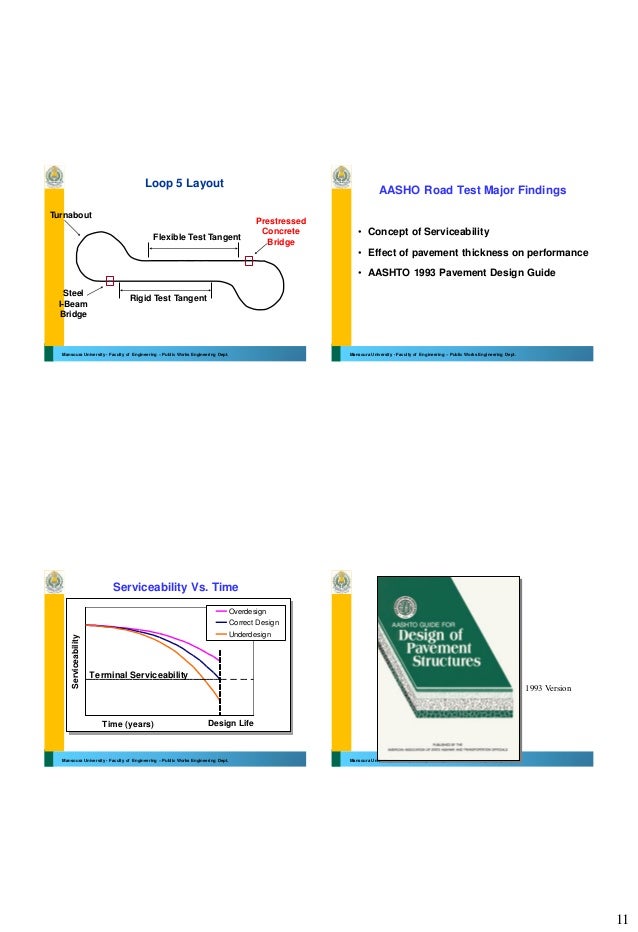

If a fundamental drainage problem is suspected, thicker layers may only be of marginal benefit – a better solution is to address the actual drainage problem by using very dense layers (to minimize water infiltration) or designing a drainage system. Because of the peril associated with its use, often times the drainage coefficient is neglected (i.e., set as m = 1.0). Serviceable life. The difference in between construction and end-of-life is the serviceability life. The equation compares this to default values of 4.2 for the immediately-after-construction value and 1.5 for end-of-life (terminal serviceability).
Typical values used now are:Post-construction: 4.0 – 5.0 depending upon construction quality, smoothness, etc. End-of-life (called “terminal serviceability”): 1.5 – 3.0 depending upon road use (e.g., interstate highway, urban arterial, residential).

1993 Aashto Guide For Design Of Pavement Structures Pdf To Jpg Format
Subgrade support. Subgrade support is characterized by the subgrade’s (M R). Intuitively, the amount of structural support offered by the subgrade should be a large factor in determining the required pavement structure.OutputsThe 1993 AASHTO Guide equation can be solved for any one of the variables as long as all the others are supplied. Typically, the output is either total or the required Structural Number (or the associated pavement layer depths). To be most accurate, the flexible pavement equation described in this chapter should be solved simultaneously with the flexible pavement ESAL equation. This solution method is an iterative process that solves for ESALs in both equations by varying the Structural Number.
1993 Aashto Design Guide Pdf
It is iterative because the Structural Number (SN) has two key influences:. The Structural Number determines the total number of ESALs that a particular pavement can support. This is evident in the flexible pavement design equation presented in this section. The Structural Number also determines what the 80 kN (18,000 lb.) ESAL is for a given load.Therefore, the Structural Number is required to determine the number of ESALs to design for before the pavement is ever designed. The iterative design process usually proceeds as follows.