Antique Ge Fan Serial Numbers
A.C.Desk Fan. Silver Swan Desk Fan. D.C.Desk Fan. Ceiling Fan. Air Circulator. Ventilator Fan. Exhaust Fan. 1910 Manhattan Electrical Supply Co. (MESCO) Catalog (Philip Colston). Scans from Early Electrical Journals (Philip Colston). AFCA ARCHIVES ORDER FORM; GE Report No 4667 July 9 1900; Emerson Factory Photos. Courtesy of Dr. I've seen form stampings for 16” collar oscillator fans, but never as much as a photo of a 12” fan stamped with such identification. At that time G.E. Certainly was sporadic in marking those alpha-numerics; I have a 1913/14 residential without form number (or model number). By 1915 they seemed to have.
Latest update: 3-20-19Emerson fans are one of the most widely collected, and regarded by many as the best fans ever made. I, for one, have always had a hard time remembering the dates that different models were made. Here I have compiled a list of all of the 60 cycle AC brass blade fans that Emerson made from the earliest 1892 'Meston' until the last of the brass blade models, the 29646 and 71666 models. I have also added the earlier steel blade models that replaced brass in 1931.A few early models, c.1901, that you are not likely to encounter and which I have never seen have been omitted until I get more information. (Those omitted Types turned out to be 133 cycle motors). The dates given are believed to be accurate but some errors may have crept in.
Antique Ge Fan Serial Numbers
I would like to update the list where possible if readers will let me know any additional or corrected information. 1892-1898 'MESTON' Alternating Current Fan Motor desk fans with bronze motor case and switch on top front of motor, infinitely variable speeds with commutator and brushes:M1 (Meston) 12' desk fan 16,000 alternations (133 cycles)M2 (Meston) 16' desk fan, 16,000 alts1895-96 'Emerson Electric' Alternating Induction Fan Motor (not a Meston but motor is so marked) with rear switch, no brushes or commutator (mostly bronze motor cases)1897 'Emerson Electric' Induction with cast iron motor case and rear switch1898-1901 style tripod desk fans. 2210, 2220 (1909) 12' & 16', Emerson's first oscillator, two bearing motor with set screw blade(For fans listed below the first two digits are the series, the middle digit is the frequency (0 for DC, 2 for 25 cycles, 3/30 cycles, 4/40, 5/50, 6/60 cycles), the fourth number is the number of blades and the last number is half of the diameter of the blade (5 is a 9' blade on brass models but a 10' fan on later models, probably that use steel blades). Note: only 60 cycle models are listed below but other frequencies were made in most Types. Note the three voltages that each fan was offered in. In the days before the fans were convertible from desk to bracket fans beginning with the Type 1510 a separate bracket Type model was offered differing only in the base of the fan motor.Click on page to enlarge.Emerson had a design advantage over their competitors in their use of a long, single 1/2' hardened steel bearing in place of the usual two bearings, front and rear of the motor.
While some other fans used a single bearing it was not of the same size nor hardened steel as Emerson used. The long term advantage of the Emerson design was a very long life for the bearing. The less expensive line of Trojan fans did not use this single bearing but, instead, used two bearings, front and rear, in the motor. Thank you Fred for your comments and wanting to order some of our fine Type 1310 Emerson fans. Due to unprecedented demand we are sold out of that model. May I offer you the same cost for 10 each of our current models?
They are greatly improved with colorful plastic blades, a revised guard that meets the current OSHA safety standards, a stamped steel motor housing with permanently lubricated bushings, and a molded plastic line cord and plug. I'm sure you will find the changes a great improvement. I do have a lot of information that I would like to add to this blog; I shouldn't delay making additions any longer and do have some updated information for the existing blogs.Steve.
Consuming grief beth conklin pdf files. The appearance of a ghost has often been regarded as an omen or portent of death. Papuans A 19th-century missionary describes the fear of ghosts among as follows:'That a great fearof ghosts prevails among the Papuans is intelligible. The jima is said to grab a person with very strong, cold and poisonous hands and try to pull the person's spirit away. Fears of ghosts among various cultures Wari' , an, believe that the spirits of dead people may appear as scaring called jima. Seeing one's own ghostly double or is a related omen of death.
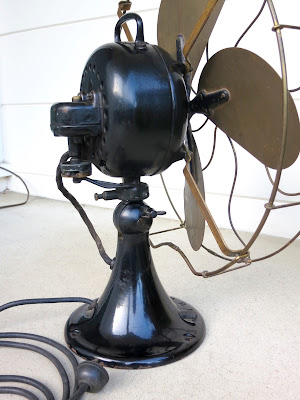
GE / General Electric Beaded Base 'Pancake' Motor 12' Electric Fan This is an early 12' GE fan with a 2 speed 'pancake' motor w/ the switch in the rear of the motor. This was a short-lived design before GE moved the switch to the base and after 1906 to a larger or wider 'tank' type motor.

Ben, it is difficult to date many R&M fans due to there not being much in the way of catalogs and other information about them. Emerson, Westinghouse and GE made it much easier when it comes to dating.
Your List 3000 is probably around 1920. I think R&M fans used a 'wrapped' cage construction through 1918, possibly a year later then went to welded cage construction. The 3000 that I had was welded and the oscillating version is the List 3600, both 9' fans (I think but I see some listed in the AFCA gallery as 10' fans).
I would go with early 1920s and that is probably as close as we can get. Nice fans they are. Hi Jeff, I have been following your posts about your Emerson on the AFCA forum.
It's very simple, you have a 50 cycle 'version' of the common Emerson 73648. 50 cycle fans are not too rare but not seen very often either. They will run ok on our 60 cycle current although you may want to raise the voltage some. A variac will usually put out about 135-140 volts plugged into a 120/125 volt circuit.
That additional voltage should help your ran run a little better but give it a try if you have a variac and see if the motor gets warmer at the higher voltage. Running at 120/125 volts will not harm your 50 cycle fan. The reason you don't see your fan in my blog is because I only included 60 cycle Emerson fan motors being as how they are, by far, the most common frequency. The middle number in Emerson's TYPE designation tells us the frequency; 0 for DC, 2 for 25 cycles, 3 for 30, 5 for 50, 6 for 60, etc. There may be some special frequency Emersons made.
Hi Rod, the 16' 14648 is a nice fan from 1912 and probably 1913. As to the value I can't help you there due to the broken base and not having seen your fan. Condition and originality or quality of a restoration plays a large part in value so photos are a must. Even then I am not very good on values. Watching similar fans on eBay or checking SOLD LISTINGS can be a good way to find values.
For the base I would suggest you place a wanted ad for a replacement base on the Antique Fan Collectors Association website on the Buy-Sell-Trade forum. No charge to do that and adding a photo of your broken base and fan would be helpful. Some fan collectors have successfully repaired broken bases from those Emersons that, not infrequently, have a crescent shaped piece broken out of the base due to improper packing. Yes, cast iron is very fragile.
Either the existing piece broken from the base cane be brazed or welded back on then finishing done to blend it into the base or the missing piece can be filled in with epoxy or JB Weld. That takes time and some knowledge but the results can made a broken part look nearly good as new. Search the 'pre-1950 forum' for any posts that have been made on fixing broken bases.
I know that there have been several posts over the years. Good luck with your big old Emerson. Hi Larry, the Emerson 12646 is a scarce and very nice earlier Emerson and I wish you luck on your restoration. I have little experience in working deeply into fans but this thread should be of some help to you:will need to remove the rotor to get at the centrifugal start switch. There is a nut of sorts on the front of the rotor bearing after you get the fan blade off which, in itself, can be quite a chore.
If you don't know how to do that get back to me; better yet use the CONTACT ME form near the top right of this blog and I will get back to you. Once the rotor is removed you'll see the switch in the back of the motor held to the motor housing with three screws. Remove them as a first step. The switch itself with the red fiber insulator discs may be hard to remove. I think it kind of gets 'glued' to the motor and has to be carefully persuaded or pried out. The switch leads are attached to the stator (motor windings) and can be unsoldered or removed along with the stator. I hope this helps and let me know via the Contact Form if you have other problems or questions.
The AFCA website has a search function that should give you some more info. The bearing shaft, by the way, is pressed into the motor housing and should not be removed.Steve. Thank you for making this information available. Before I found this site I was taking apart my sister's Emerson 73648 using the 'look at it and figure it out' method. I thought the fan blade had a welch plug covering the nut holding it to the shaft which could be removed with hammer and chisel. It was a surprise when the fan blade come off leaving the hub on but it did open up new methods for getting the hub off.
Without the blade the front cover comes right off. There are 2 holes in the armature which will accept a pin wrench or homemade holding tool. With the armature properly held a vise grip or pipe wrench should remove the hub as long as I remember about the LEFT HAND THREADS. I am not sure exactly what you did when you say that the fan blade came off leaving the hub on as the blade is permanently attached to the hub (of the blade). Maybe you meant by HUB what is the front part of the rotor. I hope you got it all ok. Emerson blade removal can be tricky and, at time, extremely difficult.
Emersons are great fans with some unique construction. If you want you can contact me via the CONTACT ME at the top of this blog. I will send you my email so you can send photos if I can be of help. A good question Eddie and it's sometimes possible to accurately date Emersons.
From 1929 Emerson started to include what we call a 'date code' on the motor tag of seemingly all of their fans and continued into the 1950s. Look for a small two digit (1929 was a single digit) in the lower right corner (or in other locations on other models) and add 20 to that date code number. The first date code on the larger fans, 12 and 16', was '9' so that would have been made in 1929. So how do you date an Emerson made before 1929? Their JUNIOR models had a date code earlier starting maybe with a '1' but I have seen a '3' which would be 1923. The larger fans had no date code. In 1925 or 26 the new 'Built to Last' cage badge was introduced so that will get you closer.
Before that I don't know of a way to closely date the larger Emerson fans. Other changes over the years such as the change from the low 'screen door' carrying handle to a higher handle are hard to impossible to date. Again, an educated guess after looking at a number of Emerson catalogs posted on the AFCA website (for members only). The 73646 was a successor in 1937 that replaced the old 29646 last offered in 1936.
The 73646 gained the force feed lubrication feature that the 16' 63648 had had for a few years. The 73646 AK continued through at least 1939 (don't have access to a 1940 catalog) and that seems to be the end of that model other than a chrome plated version in 1914, also 73646 AK.
The replacement for the 73646 was the 79646 AQ in 1942. The best I can tell is that the 73646 kept the old Parker blades from the later 29646s but the 79646 had a very different style of blade. The catalogs don't mention that I saw what the AK or AQ or other letters were for but it could be various changes in specifications and, on some models, possibly the color variant. Good workhouse fans of the later 1930s.
Vintage Ge Fan Date Codes
Hi kristinafina. 2631 only means 'Name Plate # 2631' and is the part number I would say for the name plate itself but not anything meaningful. You should be able to date your fan to a particular year. Look on the motor tag in the lower right hand corner for a very small two digit 'date code'. Add 20 to that number to get the year your fan was made. Hopefully the date code will be visible. I have a 79646-AT with a '28' date code making the fan from 1948.
I like these fans, very well built. I can't tell you what the 'BB' means on the Type number but it's probably specific to the government model which has some differences from the civilian models.